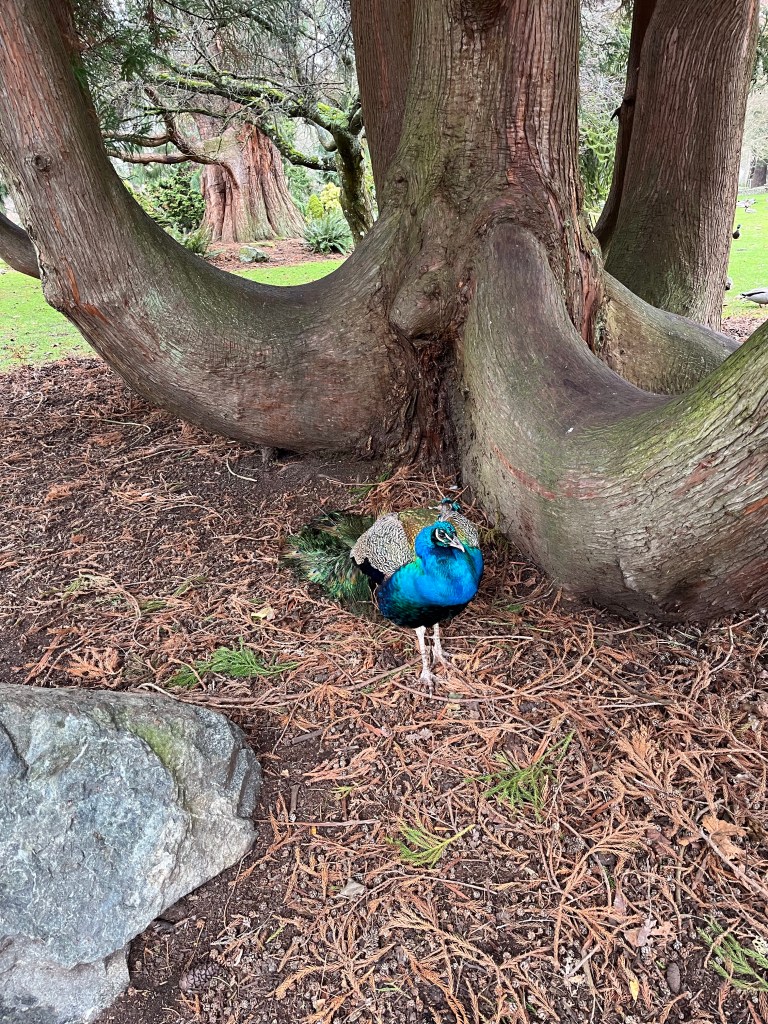
I took this photo two weeks ago while on a walk in the park. It wasn’t until I posted it on social media that I noticed the contrasts found within the photo.
The curves of the scooping Sequoia trunks; the sharp edges of the rock. The iridescent blue and green of the peacock; the brown soil and dead sequoia needles. The bright green moss on top of the dark branches. The still and quiet ground in the forefront; the branches grasping toward in the distance.
There are straight lines, curved lines and crooked lines, thinness and roundness; permanence of the old-growth trees and large rocks against the youthfulness of the peacock.
When I took the photo, I snapped 3 quick ones hoping that one would turn out to be clear and somewhat interesting. At the time I had no idea how much I had captured in that split second.
Lately I have gone on several long walks each week. My neighbour’s mother moved to Canada over a year ago and has made very few friends. Speaking English is definitely a challenge for her, and we have now schedule walks on Sunday morning when we are both available. I am learning a lot about her experience working as a doctor in her native country, and she is learning how to communicate more easily in English. Next week I will take her to Fisherman’s Wharf.
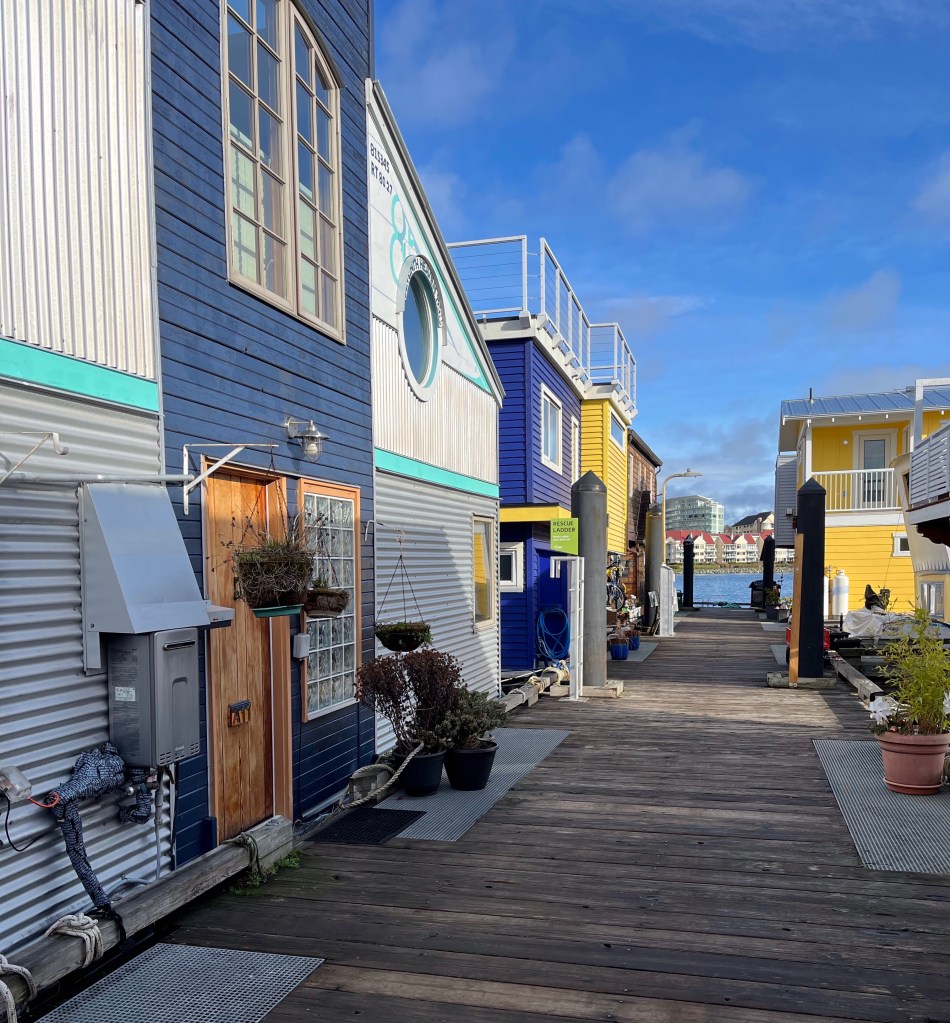
This photo was taken the day before while on a walk with a close friend who has found the isolation of living in a pandemic quite difficult. We try to go for walks regularly, and when the weather is warmer, will sit outside on restaurant patios enjoying a meal or a beverage, and talking about our very different lives.
As we walked at Fisherman’s Wharf we talked about how living on a float home was at one point quite appealing to each of us, but we quickly came up with reasons why it would be quite horrible! The wharf is located about 10 minutes walk from the cruise ship terminal. During cruising months, April to October, hundreds, or maybe thousands of people walk into the wharf area each day. There are several places to eat seafood, ice cream. There are whale tours, kayak rentals and boat taxis, gift shops and buskers.
The signs in front of several of the homes gives an indication of what the owners deal with from some of the tourists. “This is not a museum, please don’t enter”, is one example. Many of the windows are now tinted, others have the blinds pulled.
I think that living in such a cute little neighbourhood, perfect for gawking tourists, and a place where locals love to come for fresh seafood, would quickly feel like I was living in a fishbowl.
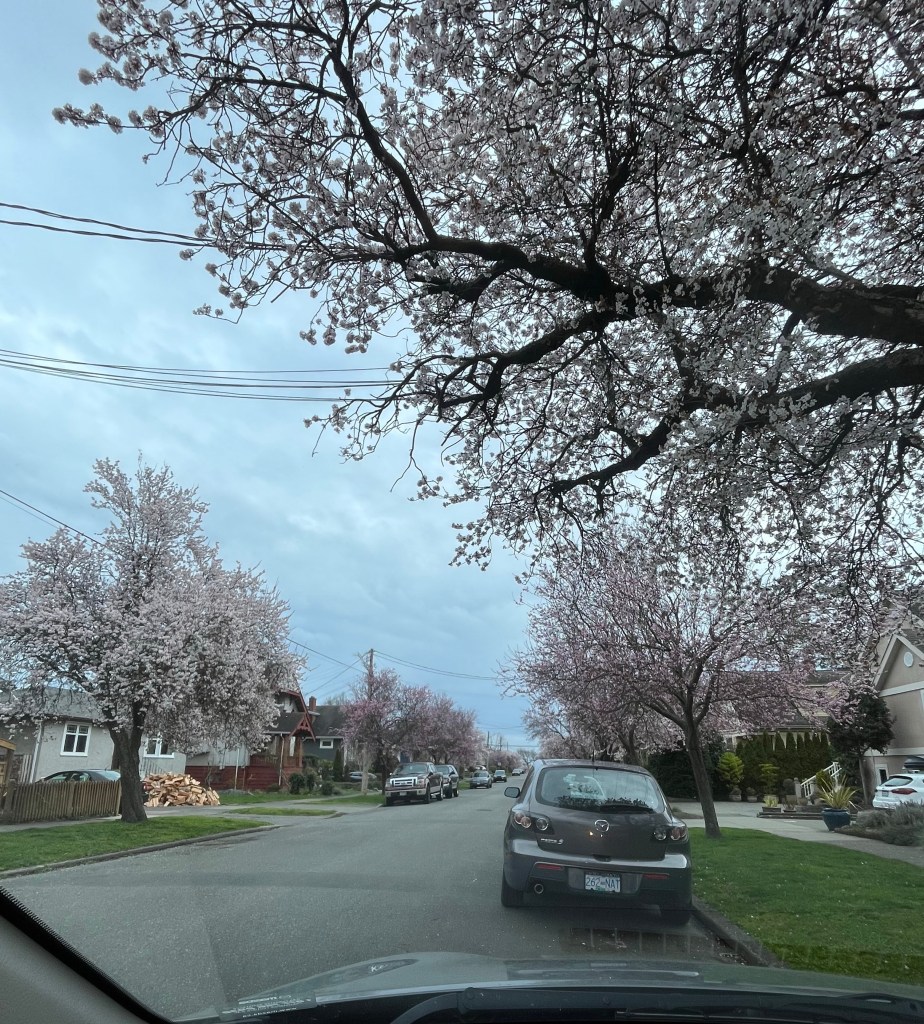
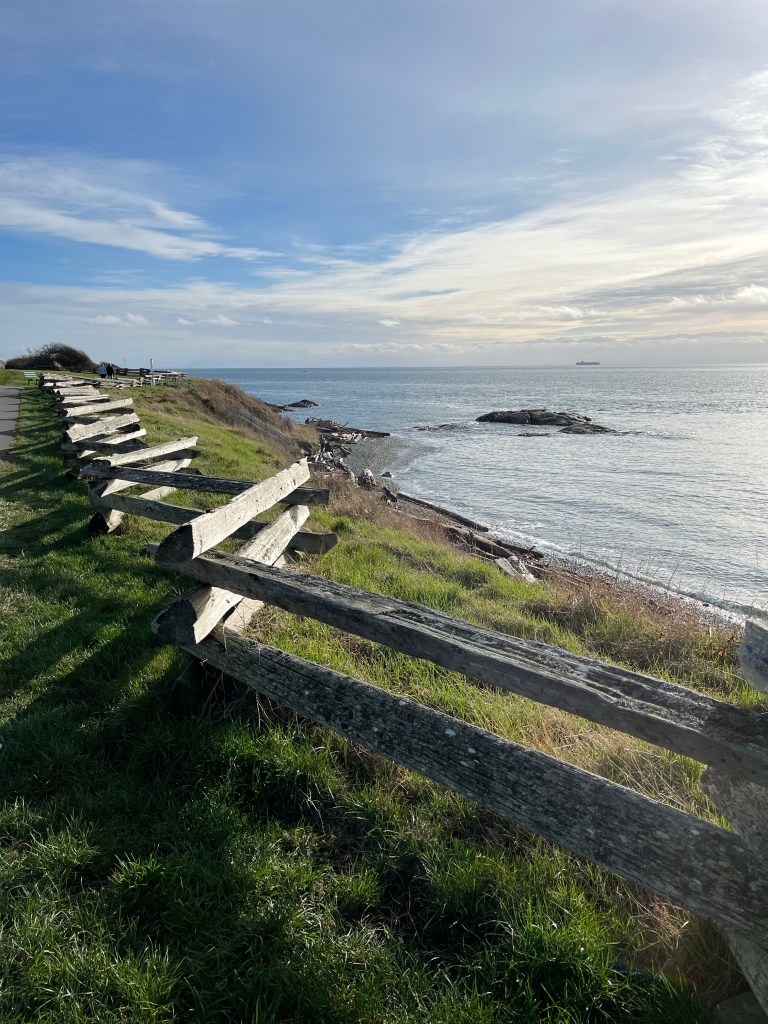
I took this photo while on a walk several days ago. Later, while I was listening to some music, I noticed that I had left this photo up on my iPad. The music seemed to fit it perfectly. Normally I don’t connect photos with specific sounds or songs, but this time was different.
The lines, the curves, the colours and light, clouds, ship, grass and rocks, all brought more to life as I listened to the Kyrie from Palestrina’s Missa Benedicta es.
The Isolation Journals prompt for this week is to “write a goodbye you wish you’d said, or need to say.”
Over 34 years ago my little brother was lying in hospital, dying from cancer. I was living and working overseas, with 3 young children and a 4th on its way. My husband knew how much I needed to spend time with my brother and sold his prized possession, a Kawasaki motorbike, in order to finance the trip.
I stayed in Canada for 3 weeks, taking the night-shift vigil at the hospital. Most of the days were also spent at Ron’s bedside, along with our other siblings and regular visitors.
Still in my 20’s I had very little experience saying goodbye to loved ones who were dying. I didn’t have the words to say, and could not express my feelings by showing physical affection.
Those three weeks went by quickly, and the time came to say goodbye and return to my family in Thailand. The “goodbye” was just that. Goodbye. I wish I could stay longer. No tears, no hugs, no loving words. Just goodbye.
If I could go back in time I would tell him much I admired his kindness, his brilliance, his gentle spirit. I would thank Ron for all the great memories of our hikes and adventures together. I would tell him how much we would all miss him. I would make sure to give him the biggest hug possible—one that would gently surround him without adding to the pain of his tumours. And I would squeeze his hand one last time before whispering goodbye.
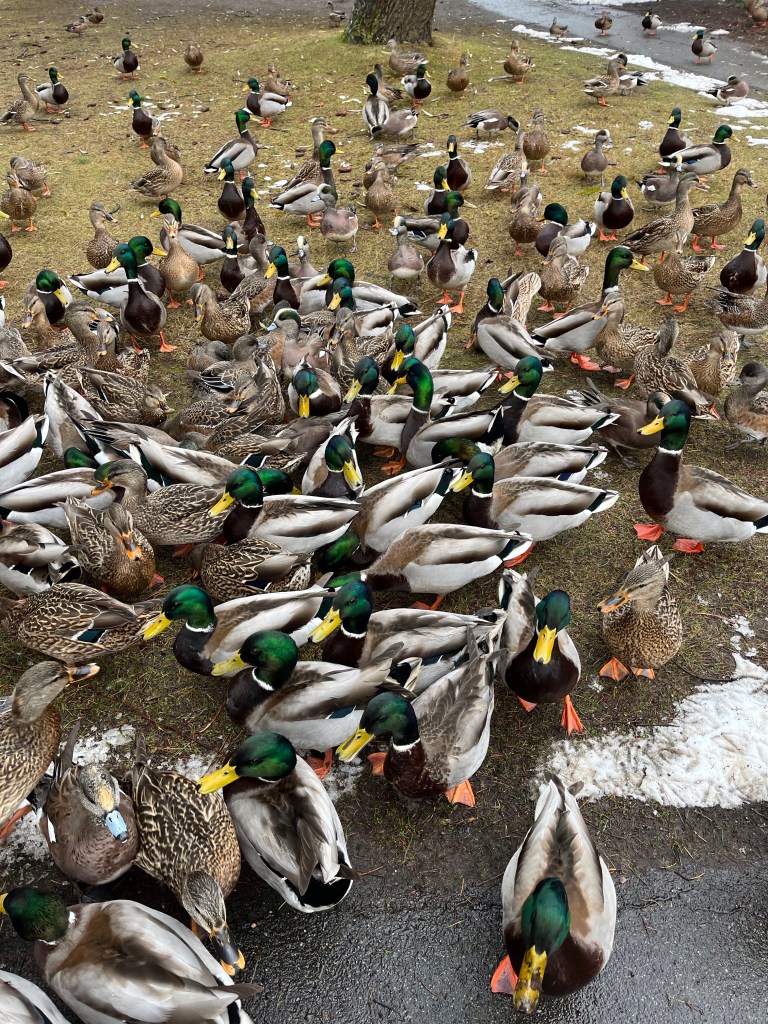
On Christmas Day I walked though Beacon Hill Park with a friend to feed the ducks, and chat. That day was very quiet in the park so we could take our time and wander, looking in areas we seldom walk. I showed my friend the “Hands of Time” sculpture at the top of the hill near the look-out, then we walked past this.
My first impression of The Moss Lady was that the face was similar to some of the thinner Buddha statures and photos that I have seen. And I felt that she looked like she was emerging from the earth. This morning I researched the history of this artwork, and now I see it differently. In the spring, the moss which covers her body will be green again, and flowers will once again surround her head. The peaceful look on her face as she sleeps reflects her surroundings.
Artist, Dale Doebert along with city staff built the 35-foot long woman in 2015. He had seen photos of the Mud Maid in the Lost Gardens of Heligan, in Cornwall, England. This is her twin.
Over the years I have learned to not trust my first impressions. I misread people so easily. Those I don’t like on first meeting have often become close friends; others I trusted immediately upon meeting took advantage of my trust and later betrayed it.
Just as in my misinterpretation (or alternate interpretation) of The Moss Lady, I know I misjudge intentions of people I meet. I need to continue to do my research and give people time before I make a judgement.
If only people were as easy to read as the ducks in the park. Their only intention was to come scrambling for food. No love, no betrayal, just food!
Dad was a very organized person. He kept files in a filing cabinet in the laundry room. Each file was neatly labeled “insurance”, “appliances”, “house”, etc. He had files for interesting things from his life, and another for mom, and of course one for each of us. One of my goals on this recent trip to visit mom was to sort through some of the files and take home anything that might be important.
Last weekend I discovered several letters that mom had written in 1993 and 1994 to her local MP, Revenue Canada and the federal Minister of Finance, along with the responses from the men in those positions.
She was not pleased that the government was charging GST on brassieres for women who have had mastectomies. The CRA reasoning was that women could buy one with a doctor’s prescription. Mastectomy bras are included in the list of medical devices which are exempt from GST under certain conditions, e.g. doctor’s prescription.
Mom’s argument was clear and simple—this is not an item people without surgical removal of one or both breast would purchase, therefore it’s obvious that they would not be taking advantage of any unnecessary tax relief.
By September, 1994, mastectomy brassieres could be purchased in Canada without added GST, even without a doctor’s prescription. This was one of my mother’s accomplishments!
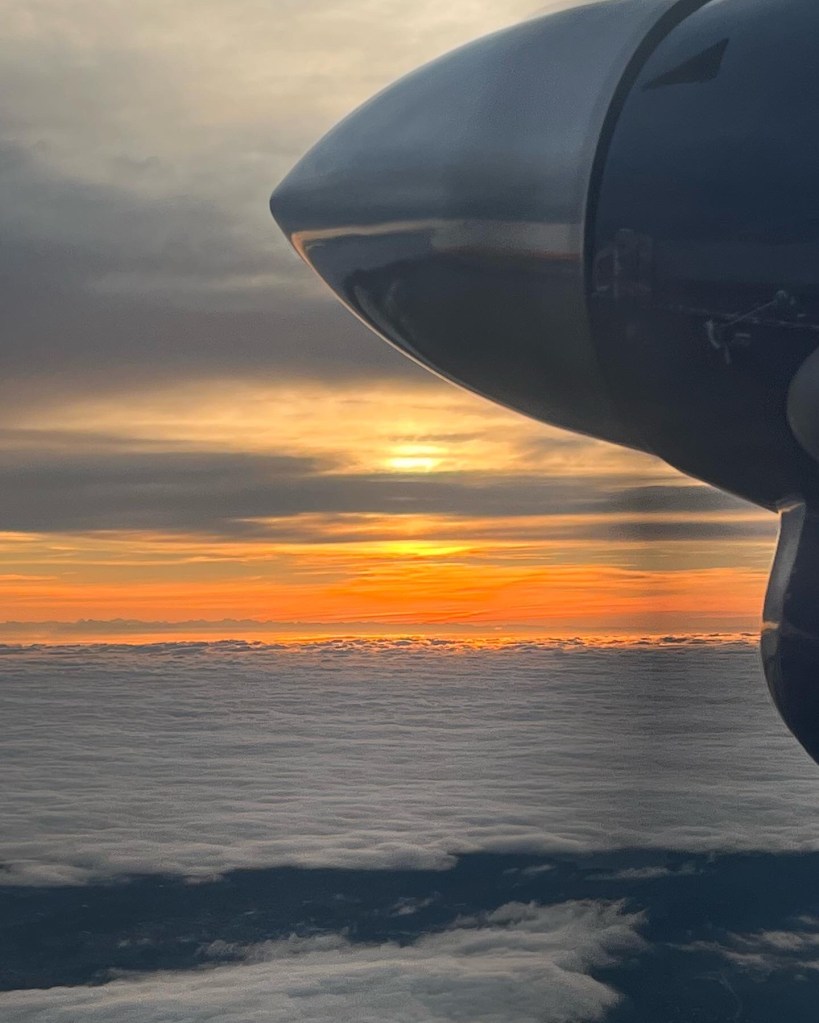
I am once again heading back to mom’s home. This time I am flying in order to avoid snowy mountain roads and potential blizzards.
The cloud formations are mesmerizing, with the sun peaking through between various layers of cloud types. The …. Straight reflect the sun, and in the distance I can see snow no longer only in the mountain peaks.
I chose not to bring a book to read on this flight, hoping to doze off. That’s not happening! Even small turbulence is scary in these small 21-seater airplanes; 23 if you include the pilot and copilot/flight attendant. Every seat, except the middle of the back row is a window seat.
The past several weeks have been a whirlwind of activity for me—seasonal performances, meetings, a creative writing course, seemingly endless emails with my brother trying to sort out mom’s finances, and the usual workload. I am looking forward to a more relaxed couple of weeks coming up.
I signed up for a creative writing course. My choice of this course had little to do with the actual topic, but more to do with available time in my schedule and the fact that it was 100% online. We have had 3 sessions, with two remaining. The other students are so much more experienced than I, and came prepared with partially written short stories. They all have very imaginative topics, from mystery to science fiction, murder mysteries, horror, etc. I had to improvise when I was put on the spot, and thought of my most interesting ancestor — my great-grandfather. I can’t seem to come up with random stories that have nothing to do with people I know…
One big truth that has come out of this process is that writing is more than just coming up with a great idea, and having an amazing imagination, it’s about knowledge and effort. Lots of effort.
The assignment this week is to write a Dribble (exactly 50 words), Drabble (exactly 100 words) or a Postcard (250 words). Here is my Drabble “Buried Boots”:
What amount of gold is worth isolation, illness and death?
Campfire smoke, memories of home, remorse over his massive mistakes choking him with every breath.
Angus learned of more deaths among the prospectors. Typhoid. Accidents. Death at the hands of greedy stampeders.
Tomorrow he will head home, without his fortune. All that remained was a tiny collection of nuggets hidden inside his boots—just enough to take home as souvenirs.
The heavy weight of guilt from a lifetime of blunders slid away, just as the escarpment thundered toward the campsite.
Perhaps his boots will make it home to his family.
Today marks one year since my father passed away. It has been a tough year in many ways, but also a good growing experience.
I started thinking about the mourning rituals I observed and participated in while living in Thailand. When my father-in-law passed away we held several days of evening services and meals for the community — family and neighbours and friends. Each night there was singing, praying and preaching followed by delicious food, prepared and serviced lovingly by his children, grandchildren and other relatives. The final day of celebrating his life, all the attendees drove to the cemetery in a long caravan of vehicles. There was some prestige in having a long caravan.
Following that, we (his children and their spouses) wore black for 3 months. Some people mourned their loved ones by wearing black for 3 days, 3 weeks, a year. That defined period allowed the bereaved to step back from normal activities and spend some time in their grief, without having to explain. What I found helpful was the “permission” to end that period of grief. At the end of those 3 months we could get on with living and enjoying life, without any feeling of guilt that we hadn’t been sufficiently sad and despondent, and that we had paid the tribute that was expected by the culture.
This morning I had a talk with myself, and have decided that one year is a good time to get back to living without regret. I will always miss my dad. Each day I still have fleeting thoughts that I should phone him and share some news with him, before remembering that he is gone. The things he taught me by example and words will be with me forever. And one of his clearest examples was that the best way to move on from grief is to literally move on and discover new opportunities.
Music is seldom just on in the background in my house. I don’t use it to fill the quiet. When I listen to music, I am really listening and studying it — either to prepare for a performance, listening for interesting chord progressions and harmonies, to find new songs for my choir or looking for ways to improve my own music-making. And sometimes to improve how I approach life.
This morning the lyrics of Tim McGraw’s song “Live like you were dying” jumped out at me. I know I have heard it before, most likely while driving across the country with my daughter this past summer. She loves country music. It’s not my first choice, but I am growing to appreciate it more. The lyrics are often quite powerful.
“I went sky-diving”…definitely not my choice in things to pursue when hit with the reality that our end date, or even best-before date might be closer than hoped.
“And I loved deeper And I spoke sweeter And I gave forgiveness I’d been denying”…all very good things to ponder.
“Someday I hope you get the chance To live like you were dying Like tomorrow was a gift And you’ve got eternity To think about What you’d do with it What could you do with it What did I do with it? What would I do with it?”
Those were the words that really hit me. What am I doing with the days that I have? Would I be happy looking back at all the time that is wasted or spent being angry and resentful?
But, even more important, what are my equivalent-to-sky-diving activities? What would I choose to spend my time doing if I actually acknowledged the simple fact that even I will have an end date?